Flames Scoring Chances Through 10, a Follow-up
As noted below, Scott was good enough to gather together my scoring chance counts from games 1-10. Some notes before interpretation:
- My definition for a scoring chance was: a puck directed at the net from a certain portion of the ice in the offensive zone. The area I determined to be prime chance real estate was a triangle or pie shape, extended from the goal up to about the top of the face-off circles. Shots from the boards and point shots were therefore excluded. Also excluded were shots blocked close to the source, meaning, a shot wasn't counted as an opportunity if it had no real chance to get by the shin pads in front of it. Also excluded were "chances at chances", such as a pass through the slot which is missed by the recipient or, say, a botched two-on-one where the puck is intercepted by the defender or the shot fanned on.
- Obviously this method doesn't "rate" scoring chances themselves. A break-away is obviously a better quality chance, than, say, a shot from the slot through a bunch of traffic and defenders. However, I discovered the amount of really high quality chances is actually pretty small in every contest, so it's not a big issue.
- I tried to be as true to this criteria as possible, but there was still an element of subjective judgment involved. For example, you'd be surprised how many shots originate just outside the range defined here (top of the face-off circles or slightly outside the face-off dot). Also, deflections can be very challenging to define as chances, since they are so random and unpredictable. Sometimes it's unclear whether the puck hit a defender or an attacker and/or if the deflection was in any way purposeful. As such, I was pretty ruthless about counting deflections, often cheating to the "not" side of things. Of course, I also tried to count everything the same for either team and no matter who was on the ice.
Scott was good enough to post the totals below, but I thought the ES differentials would be nice to have as well. Here they are, in ranked order.
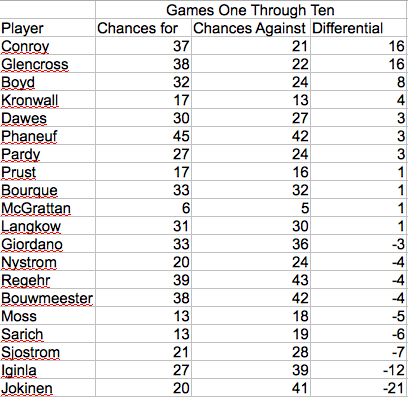
Keep in mind, this is just a 10 games sample (a mere one eighth of the season) so all the caveats that come with small samples apply here. For example, Boyd, Glencross and Conroy were a unit to start the year and they had a couple of games where they knocked it out of the park by this metric, which is why they are way out in front of the pack. I would expect that difference to settle out over time because, as much as I like each guy, I doubt that trend will hold all season.
It shouldn't be any surprise to anyone that Iginla and Jokinen are pulling up the rear though. They were, without hyperbole, horrendous in October which was exacerbated by Sutter beginning the season by going power vs. power. However, the fact that Jarome was playing some of his worst hockey in recent memory, faced tough circumstances and was still well clear of Olli (who spent some time on the third line during this period I believe) gives us an indication of who the weak link was.
I would have liked to apply some sort of standardization to correct for ice-time, but, short of combing through the first 10 game sheets and adding up each players ice-time (which I don't think I have the patience for), there isn't any way to look up each guys ice time through the first 10 games only. The reason this would be interesting is it would give us an idea of how many chances a guy is generating, say, per 60 minutes of ice. Eric Nystrom and Olli Jokinen were on for the same number of scoring chances through 10 (20 each), but one guy tends to play a lot more than the other. A rate per hour would give us a better idea of what each guy is doing above and beyond the raw totals. Something to keep in mind for the next round, I guess.
0 recs |
17 comments
|
Comments
While I find this to be an interesting metric are you sure calling it “Scoring Chances” is the best describer? I, personally, would consider a point shot on a perfectly screened goalie that’s rung of the post/crossbar to be a scoring chance I also tend to think of the things that you refer to as “chances at chances” as scoring chances. But I do think that this is a nice way to rate shot quality.
Keep up the good work!
I dont really consider screened point shots to be good chances. Chances? Sure. Every shot on net has a value above zero, because every shot has some chance of going in. But we’re trying to capture the higher than average chance on net here…which is why I also exclude chances at chances. Would you count a guy on break-away who trips over the blue line a scoring chance? how about the cross-ice feed that’s fanned on? The cross-crease pass that hops over the intended guys stick? The break-away pass that is knocked away at the last minute?
I guess you’re right though…another name would maybe clarify things.
by Kent Wilson on Nov 13, 2009 10:35 AM PST up reply actions
Well, I guess in my mind, it depends on what you are wanting to do with the data in the end. If it is data that you want to use to see how tight/loose defensively a team (or player) is playing, then I think knowing the number of ‘cross-ice feeds’, break-away trips etc. will change things because eventually, the habits/mistakes that are leading to numerous breakaway ‘chances’ that the player didn’t get a shot on will start going in the net.
Here is the question:
Was the Gomez breakaway in last game a good scoring chance?
I don’t want to bog you down in the black-hole of this, but I think it needs to be total chances, chances eliminated, chances created or something of that sort.
Maybe another question is what do you hope to be able to conclude at the end of this data gathering that gives us more insight into the specific situations each player is involved in?
Unfortunately, like all measures, not everything is going to be captured because you eventually need to draw a line demarcating what it is and what it isn’t. To some degree, it’s arbitrary, thus a loss of data.
This is what I’m truly looking for with this: shots from dangerous areas on the ice for/against when player X is on the ice.
by Kent Wilson on Nov 13, 2009 11:02 AM PST up reply actions
Yeah, I understand that, but I guess ultimately part of the difficulty I am sure you know all too well is this. To my eye, the Gomez breakaway was a good scoring chance. I think most would agree. However, Gomez didn’t get his shot off, because he lost control of the puck, so it wasn’t even a shot. You can’t score without it being a shot…hence the logic of the post ruling on SA. Again, most would agree. Here in lies the paradox: If Kipper is not in the net (say he has been pulled) it’s a goal, undoubtably. So the question is this then: Did Kiprusoff save a goal, just by being in the net?
In my mind, his presence, was as good as a save on that play, because he ‘forced’ the play. Now, this is easily debatable, but surely if he wasn’t there Gomez scores.
Call it the Hasek effect. Hasek had players so psyched out when they played him, they would pass up great opportunities to score, because they often thought he would save it, so thay looked for the prettier play…which often resulted in a dribbler into the pads.
CG and I have debated this in other words and other ways. But I can tell you as a goalie…the more consecutive shots you save, or the other team doesn’t get off, the easier you job becomes throughout the night. It’s my hunch as to why goalies on poor defensive teams have unusual frequency of very high save %, but that remains to be proven, and likely impossible to do so.
Well, 9.9 times out of 10, players gets shots on break-aways, so that would be counted as a scoring chance almost every time it happened. On the other hand, I have a few shots counted as scoring chances here simply because they went in the net, even though they weren’t really chances at all by my definition. On the balance, the assumption is that extreme events equal out over time.
by Kent Wilson on Nov 13, 2009 11:31 AM PST up reply actions
Fair enough, I’ll err on the side of that being true to save our sanity. However, I will say this…somewhere in all of this is a hugely impossible conversation about randomness, ‘over-time’ being in 60 minute chunks vs seasons vs careers etc.
As well, I think nhl.com shootout data has shots vs attempts on penalty shot chances at around 85% of the time as opposed to 99% (I can’t find where I had that number from…but the attempts page shows the number of chances with missed shots.) This number sounds about right to me for breakaways, mirroring shootouts….if not a little high…I would say 8 of 10 are shots….6 of 10 quality shots….4-5 of 10 goals.
It is interesting, in my mind, that perhaps the most decisive play (or second to Iggy’s goal) to get the Flames the win vs Montreal, goes down in the statistical abyss of the NHL as a complete and total non-event. No credit, no record, no shot, no save. In a way, it’s impossible that these average over time, because, the one end of the spectrum isn’t even recorded to be a factor in the equation.
But I’ll leave it at that for my input, because I’m even starting to annoy myself. Your thoughts are always welcome in response though.
I understand your misgivings about a major event in the MTL game being unrecorded as significant by the numbers. As you say, it’s not even recorded in any way besides the shift charts – it wasn’t a shot, it wasn’t a save, it wasn’t anything because Gomez mishandled the puck. Considering the player he is, I’m guessing if he was given 10 chances to do it over again, he’d get a shot at the net on at least 9 of them a probably score on more than half. But that’s why we’re trying to do this over an entire season. Meaning, in 9 parallel universes, I count that as a scoring chance.
(As an aside, there’s a chance I did score the break-away as a scoring chance anyways…from my initial angle, I probably thought Kipper made the stop or Gomez at least got some sort of shot off. So this may all be moot.)
by Kent Wilson on Nov 13, 2009 12:12 PM PST up reply actions
Nice of Iggy and Sex Panther to make sure their differentials matched their uniform numbers (give or take a minus sign).
haha! I didn’t even notice that. Good catch.
by Kent Wilson on Nov 13, 2009 11:35 AM PST up reply actions
I should also note that, ideally, when it comes to measures of this fashion, each contest would be observed and scored by a panel of independent judges. Then, the scores could be compared and outlying events for each guy discounted. Meaning if judge one awarded a scoring chance at 5:52 to the Flames, but none of the other judges agree, that chance would be discounted.
Of course, there aren’t exactly a lot of volunteers for this so we’re a few steps away from the ideal.
It’s an incredibly time consuming process and when you’re done, you have idiots like Lawrence who haven’t lifted a finger bitching and complaining about everything.
I’ve said this a thousand times already, but the biggest obstacle to statistical analysis in hockey is simply compiling all the raw data. I don’t think we’ll ever get to the point where stats will enhance our understanding of the game, but I think a realistic goal is to create stats that give you a good feel for how well someone is playing without watching them at all, and I think we could get there if there was some cost effective way to get all raw data.
I want to start tracking turnovers because I’m convinced that they drive goals and scoring opportunities more than anything else, and I think you can measure the “severity” of the turnover by measuring where the puck was turned over and where the opposition gained possession, but I have neither the time nor the inclination to do this unless somebody paid me. I know there is hockey teams that are doing this, in fact I’m 100% certain there are, so right now I’m banking on a disgruntled statistician being fired from his team and then leaking his spreadsheets to the internet.
you have idiots like Lawrence who haven’t lifted a finger bitching and complaining about everything.
Thanks for stopping by an adult conversation, it would help if you behaved like one. I didn’t realize that this was a forum where others couldn’t express their own interests and questions on the matter. I also, didn’t realize that my questions/comments were going to hurt your feelings so much that you feel the need to outright insult someone. Thanks again.
I don’t understand why somebody from the Herald or something doesn’t get some high school or university student to do an unpaid internship or something where one of their tasks is to record all this shit for a full season of the Flames.
The problem is getting unpaid labour to do the grunt work, and the only I figure you can do that is if you can let a kid stick Calgary Herald internship on their resume. I ran the idea by Staples, but he ignored me.

by